Methodology
Indicator selection
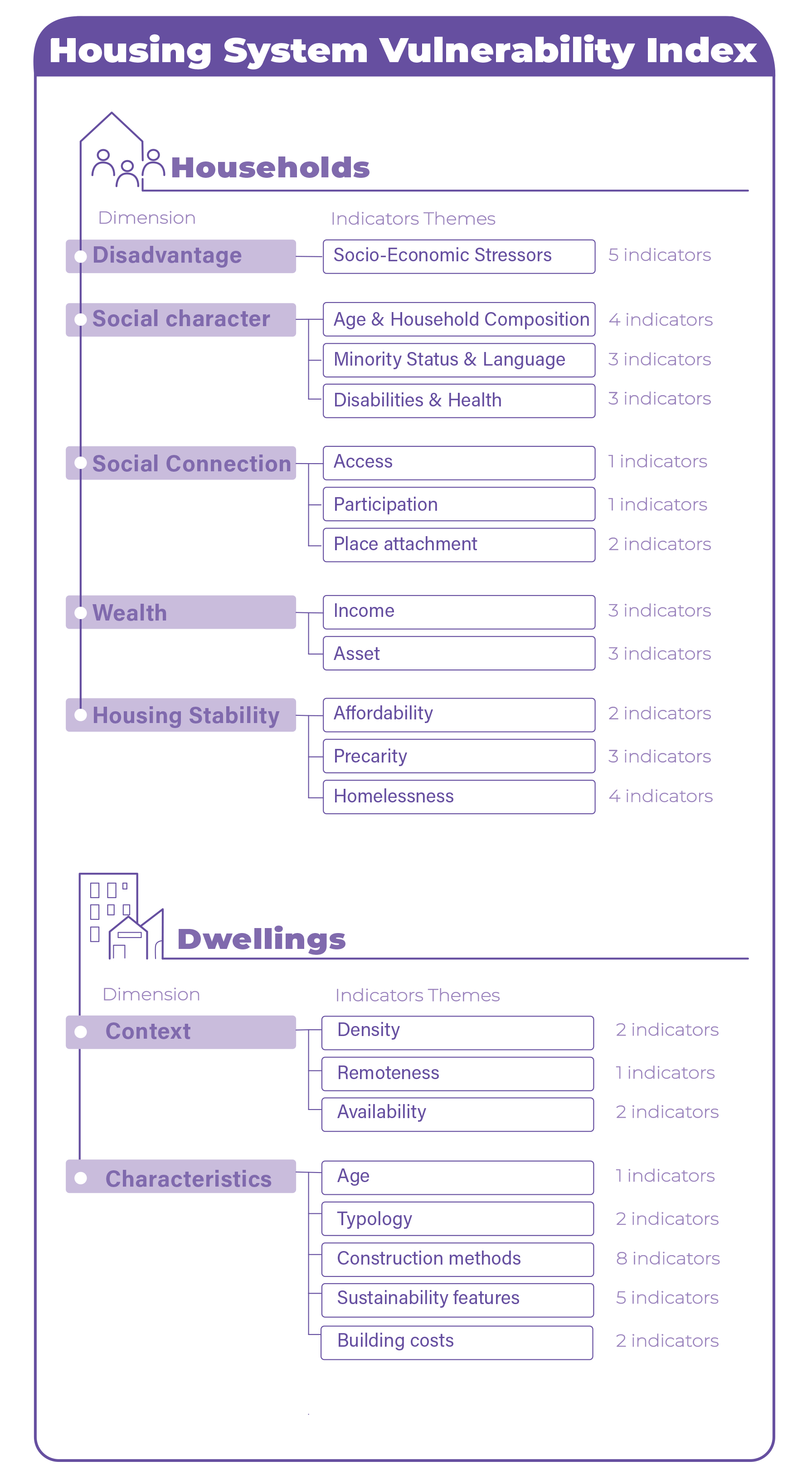
Indicators were selected and evaluated through a multi step process designed to balance conceptual rigour with practical usability...
Over the past decade, successive extreme events have exposed deep and persistent weaknesses in the resilience of the Australian housing system.
Indicators were selected and evaluated through a multi step process designed to balance conceptual rigour with practical usability. First, potential indicators were identified through a review of the housing vulnerability literature and existing national and international indices, as documented in the report. Each candidate indicator was then assessed against clear criteria: whether it had a strong conceptual link to housing vulnerability, national coverage, availability at small geographic scales, and clarity for policy interpretation.
Indicators were also tested for redundancy and relevance to ensure they captured distinct aspects of vulnerability rather than duplicating the same underlying issue. Where multiple indicators measured similar conditions, those that were most robust, interpretable and consistently available were prioritised. Finally, indicators were reviewed to ensure they collectively captured both household circumstances (such as income, tenure, affordability stress, health and demographic characteristics) and dwelling and contextual characteristics (such as dwelling age, type, construction and energy performance).
Data integration and index construction
Once indicators were selected, they were prepared and combined using a consistent and transparent process ....
Once indicators were selected, they were prepared and combined using a consistent and transparent process. All indicators were first standardised so that measures expressed in different units (for example, percentages, counts or dollar values) could be compared and combined fairly. Indicators were then direction checked and aligned so that higher values always represent higher housing vulnerability.
Indicators were grouped under the four housing dimensions—Safe, Secure, Healthy and Sustainable—based on their conceptual role in shaping housing adequacy and vulnerability. Within each dimension, indicators were aggregated to produce a single dimension score that reflects the combined influence of household and dwelling conditions relevant to that aspect of vulnerability. These four dimension scores were then combined to generate an overall HSV Index score for each area.
During development, several alternative methods for constructing the Index were tested and compared, including data driven statistical techniques and simpler aggregation approaches. The final decision was to use an equally weighted aggregation method. This approach was chosen because it best preserves the conceptual structure of the Index, ensures that all indicators contribute in a clear and consistent way, and avoids results being driven by statistical variance rather than policy relevant meaning. It also produces stable, interpretable scores that make it easier for users to understand both overall vulnerability and the underlying drivers across the four dimensions.
Data sources
The HSV Index draws primarily on the ABS 2021 Census, which provides small area information ....
The HSV Index draws on a wide range of publicly available, nationally consistent datasets to capture both household circumstances and the characteristics of the housing stock across Australia. The primary data source is the Australian Bureau of Statistics (ABS) 2021 Census, which provides detailed small area information on household income, employment, tenure, housing affordability stress, overcrowding, household composition, mobility and selected health related characteristics. Census data form the backbone of the household indicators used in the Index and ensure comprehensive national coverage at a consistent geographic scale.
These Census data are complemented by additional datasets that capture the physical characteristics and performance of dwellings. This includes information on dwelling age, type, construction materials and floor area from Geoscience Australia; energy efficiency and insulation data for new dwellings; and indicators of housing market conditions such as property values. The Index also incorporates small area data on renewable energy uptake, including rooftop solar and solar hot water systems, which provide insight into household energy resilience and ongoing cost pressures.
Where datasets are reported at different spatial scales, data are harmonised to a common geographic unit to ensure consistency and comparability across places.
Data limitations
The HSV Index is designed to be transparent and robust, but it has some important limitations...
The HSV Index is designed to be transparent and robust, but it has some important limitations. First, it relies on publicly available datasets, which means some critical aspects of housing vulnerability—such as insurance coverage, premiums and underinsurance—cannot be included due to a lack of national small area data. Second, many dwelling indicators rely on proxies (such as dwelling age or type) rather than detailed building level information like floor height or structural reinforcement. Third, some datasets are reported at larger geographic scales and are allocated to smaller areas, which can smooth local variation. Finally, the Index reflects conditions at a point in time and does not capture recent changes or future housing development. These limitations mean the HSV Index should be used as a screening and prioritisation tool, alongside local knowledge and hazard data, rather than as a definitive measure of risk.