

About
How climate change impacts the housing system
Over the past decade, successive extreme events — including bushfires, cyclones, inland flooding, coastal inundation, and unprecedented heatwaves...
Over the past decade, successive extreme events — including bushfires, cyclones, inland flooding, coastal inundation, and unprecedented heatwaves — have exposed deep and persistent weaknesses in the resilience of the nation's housing system. These events have not only damaged buildings and infrastructure but have also revealed structural vulnerabilities embedded in the social, economic, and regulatory dimensions of the housing market.
Housing, unlike many other assets, is both a physical structure and a central determinant of wellbeing. Homes provide protection, stability, connection, and the foundation upon which lives and communities are built. When climate impacts strike, they disrupt far more than walls and roofs: they destabilise livelihoods, displace households, fracture communities, and impose long term financial and emotional burdens. For vulnerable households — including those with low incomes, insecure tenure, disability, chronic illness, or limited social support — the effects are especially severe. Climate change acts as a "risk multiplier," turning pre-existing disadvantage into acute and chronic vulnerability.
What do we mean by housing vulnerability?
Once indicators were selected, they were prepared and combined using a consistent and transparent process ....
Housing vulnerability refers to the degree to which households and dwellings are susceptible to harm when exposed to climate‑related events such as heatwaves, floods, bushfires or cyclones. It is not only about where hazards occur, but about the underlying social, economic and physical conditions that shape people's ability to cope, adapt and recover.
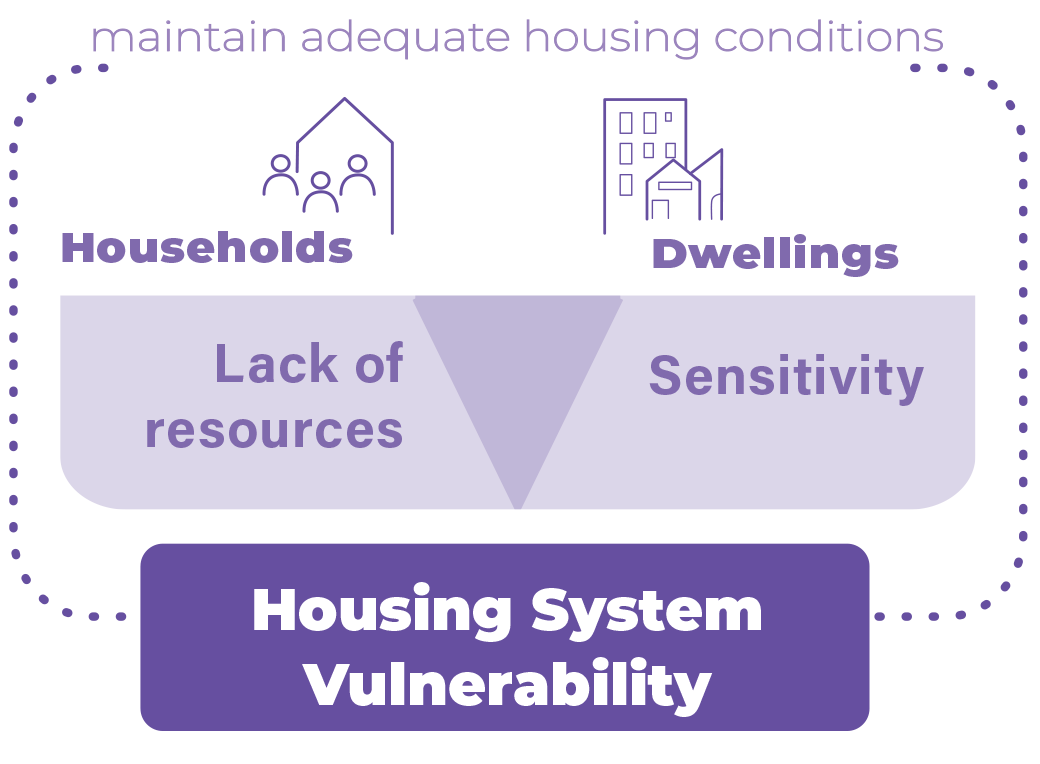
Housing vulnerability arises from the interaction between household circumstances—such as income, tenure security, health and access to resources—and dwelling characteristics, including building quality, thermal performance, location and energy efficiency. Households living in poor‑quality or unaffordable housing, with limited financial or social resources, are more likely to experience displacement, health impacts or long‑term housing stress when climate pressures intensify.
The Housing System Vulnerability Index captures this complexity by bringing together four dimensions of housing adequacy: Safe, Secure, Healthy and Sustainable.
Why the HSV Index?
The HSV Index draws primarily on the ABS 2021 Census, which provides small area information ....
The Housing System Vulnerability (HSV) Index was developed to respond to a growing gap in how housing risk is understood in a changing climate. Climate change is not only increasing exposure to hazards such as heat, floods and bushfires; it is also amplifying long‑standing inequalities embedded in housing markets, dwelling quality and access to resources. Existing measures tend to focus on hazards or recovery, but often overlook the underlying conditions that determine who is most affected when climate impacts occur.
The HSV Index addresses this gap by focusing on vulnerability: the pre‑existing social, economic and physical conditions that shape households' capacity to cope, adapt and recover. It brings together four interrelated dimensions of housing adequacy—Safe, Secure, Healthy and Sustainable—to capture how housing quality, affordability, tenure, energy performance and household resources interact to produce risk. The HSV Index helps identify where vulnerability is concentrated and why.
Using the index
The HSV Index is designed to be transparent and robust, but it has some important limitations...
The HSV Index shows how vulnerable different places are to climate related housing stress. Index scores are calculated for small geographic areas and reflect underlying conditions, not the occurrence of specific disasters. A higher score indicates greater vulnerability, meaning households and dwellings in that area are more likely to experience harm when climate impacts occur.
The overall HSV Index combines four dimensions: Safe, Secure, Healthy and Sustainable housing. Each dimension highlights a different aspect of vulnerability, from building quality and hazard preparedness to housing affordability, tenure security, health impacts and energy performance. Areas may score highly in one dimension but lower in others, revealing different vulnerability profiles.
Index values are best interpreted comparatively. Rather than focusing on exact numbers, users should look for patterns across places and dimensions. Used alongside climate hazard information, the HSV Index helps identify priority areas for targeted, preventative and equitable housing and climate policy responses.